Color blind test
Plate 01· demonstration1 / 15
- 1DemoNow
- 2Red-greenTo do
- 3Red-greenTo do
- 4TypeTo do
- 5Red-greenTo do
- 6Blue-yellowTo do
- 7Red-greenTo do
- 8Red-greenTo do
- 9Red-greenTo do
- 10Red-greenTo do
- 11Blue-yellowTo do
- 12Red-greenTo do
- 13TypeTo do
- 14Red-greenTo do
- 15Red-greenTo do
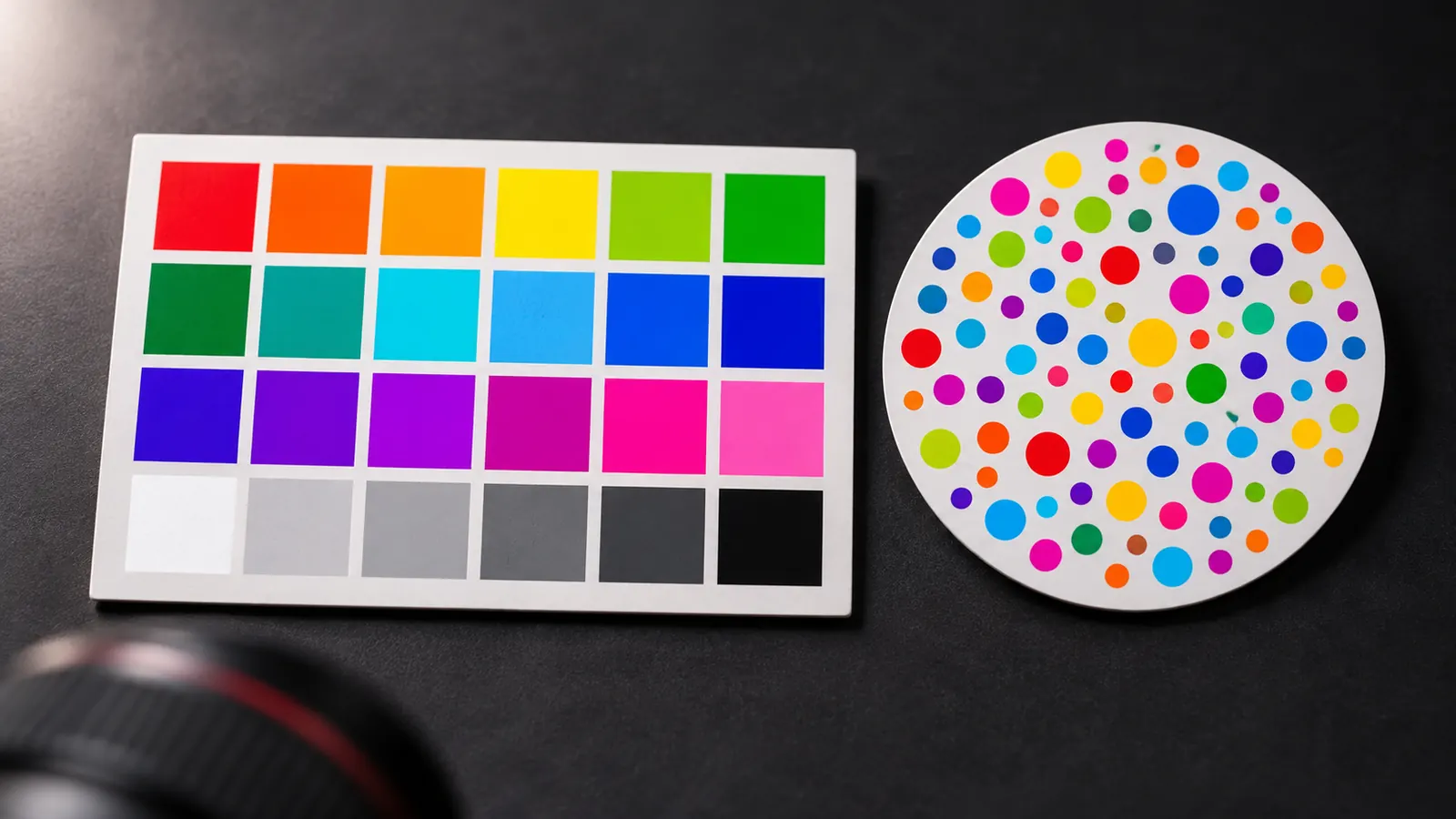
Four different grays? Your screen is ready.
How this test works
A color blind test shows plates of dots with a number hidden in them. This one has 15 plates, takes about 90 seconds, is free and needs no sign-up.
The plates are drawn in code and are new for every run, so the answers cannot be looked up. The first is a demonstration that nearly everyone reads. Then come ten red-green plates, two classification plates and two blue-yellow plates, mixed so that easy and hard ones alternate. A classification plate puts two digits side by side: one is made of changes only red-sensitive cones pick up, the other of changes only green-sensitive cones. Which one you miss points to the type.
The ten red-green plates come in five contrast levels, from 0.16 down to 0.045, two plates each. The contrast is the cone contrast between the figure and the dots around it. The faintest level you can still read places you in a band: no sign, mild, moderate or strong. Dot brightness is varied at random, so a figure cannot be read from lightness alone.
The result is a band, not a name for your type. A lean towards protan (red-weak) or deutan (green-weak) comes from the classification plates and is shown as unclear when they do not agree. Blue-yellow is checked by two plates and is shown with low confidence on phone screens.
What it cannot tell you
This is a screening on your own screen. Brightness, night filters, color profiles and the panel itself change every plate, so the same person can score differently on two devices. The test models a calibrated sRGB screen; it is not a measurement of your eyes.
A screen cannot tell color weakness (anomalous trichromacy) from color blindness (dichromacy). Only an anomaloscope, used by an eye care professional, does that. If the result matters for work, driving or training, book an eye exam that includes a color vision test.
Questions
Is this color blind test accurate?
It is a screening, not a diagnosis. It can show signs of red-green difficulty and how strong they look on your screen, but it cannot confirm a type. For a clear answer, use a bright screen with night filters off, and see an eye care professional if the result matters.
How long does the test take?
About 90 seconds for 15 plates. There is no sign-up. Your answers stay in your browser unless you copy a result link, which holds the plates and answers so the same result reopens.
What should I choose if I cannot see a number?
Choose No number. It is a valid answer: the faintest plates can look empty even with typical color vision, and the result allows for a miss.
Can I take the test on a phone?
Yes. Turn the brightness up, switch off Night Shift, True Tone and blue-light filters, and hold the phone at arm’s length. The four gray squares under Why? show whether your screen is ready.